UI/UX Design (System)
Designed a feature for the Wikipedia platform (1B+ users) to improve contributor engagement by introducing positive reinforcement into contribution workflows.
Year :
2022
Industry :
Technology
Client :
Wikimedia Foundation
Project Duration :
3 weeks
The work focused on translating behavioral insights into clear interaction patterns that support motivation, reduce friction, and improve the overall contributor experience.

INTRODUCTION
The Design Brief
Wikipedia relies on contributors, but many new users drop off early due to a lack of feedback and unclear progress signals.
Key challenges:
"Contributors receive little to no immediate feedback"
"Contribution workflows feel complex and unrewarding"
"Lack of motivation leads to reduced retention"
This results in:
"Low engagement"
"Reduced contribution consistency"
"Missed opportunities for community growth"
USER UNDERSTANDING
To better understand the problem, I focused on contributor behavior and experience:
New contributors need guidance and reassurance
Users benefit from clear progress and feedback loops
Motivation increases when actions feel acknowledged
Key insight:
Small moments of feedback can significantly influence whether users continue or abandon a task.


DESIGN OPPORTUNITY
"Using the existing system, how might we help experienced editors (Mentors) provide positive feedback to encourage newcomers to continue making edits?"
CONTEXT
Wikipedia’s mentorship system connects experienced editors with newcomers to support their early contributions. While the system enables guidance, positive reinforcement is not consistently embedded into the mentor workflow, making it harder to encourage and retain new contributors.
PROBLEM
Mentors lack a clear and efficient way to recognize and encourage mentees making meaningful progress.
Contribution activity is not surfaced in a visible or actionable way
Mentors must manually track mentee progress
Appreciation is often delayed, inconsistent, or overlooked
As a result, opportunities to reinforce positive behavior and sustain contributor motivation are frequently missed.
GOAL
Design a simple, scalable way to help mentors identify, recognize, and encourage mentees at the right moment, using clear contribution signals integrated into their existing workflow.
EXPLORATION
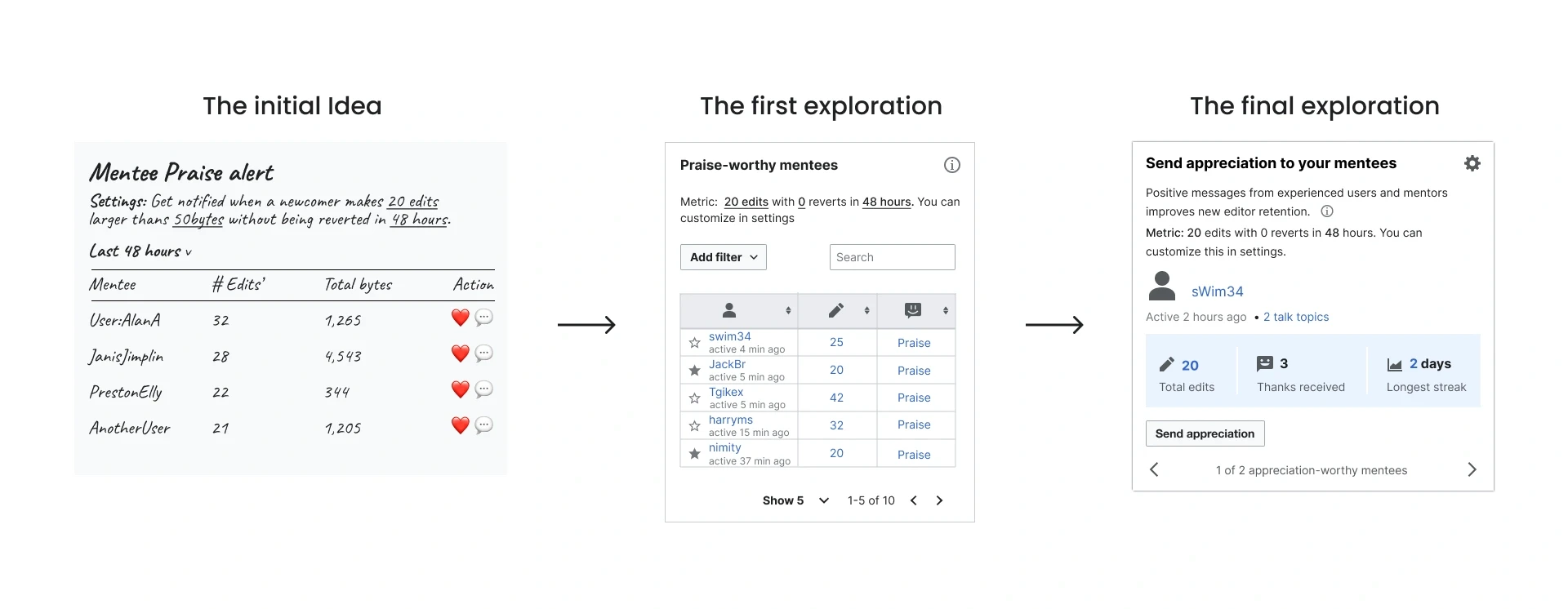
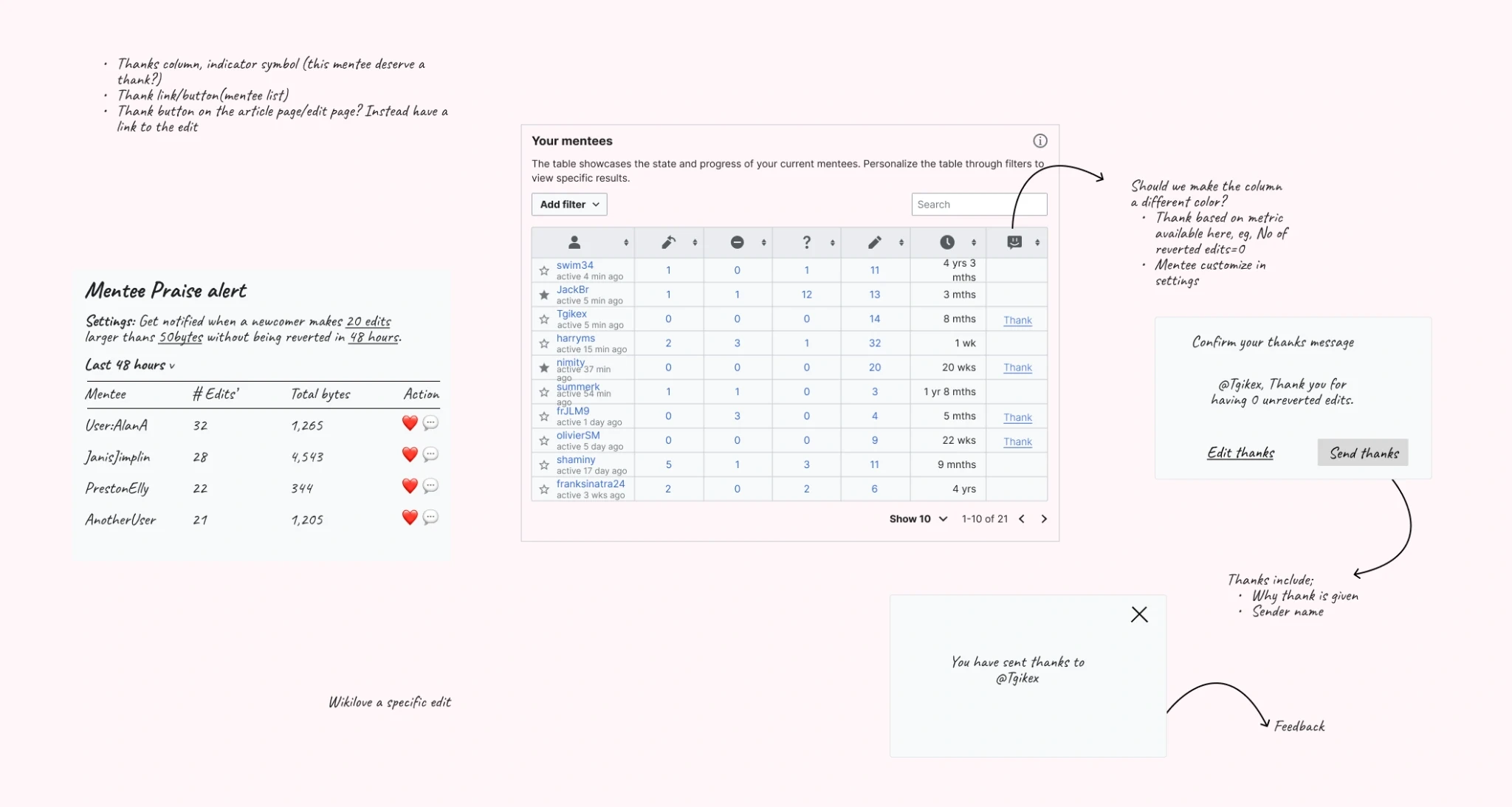
I explored how mentors currently recognize and engage with mentees, and where that behavior breaks down.
Recognition is passive — mentors must manually notice contributions
No clear signals — it’s hard to identify who is making meaningful progress
Delayed feedback — appreciation often comes too late, or not at all
From this, I focused on a simple question:
How might we make appreciation timely, visible, and effortless for mentors?
This led to the idea of proactively surfacing mentees based on contribution signals, rather than relying on mentors to discover them.
FINAL SOLUTION
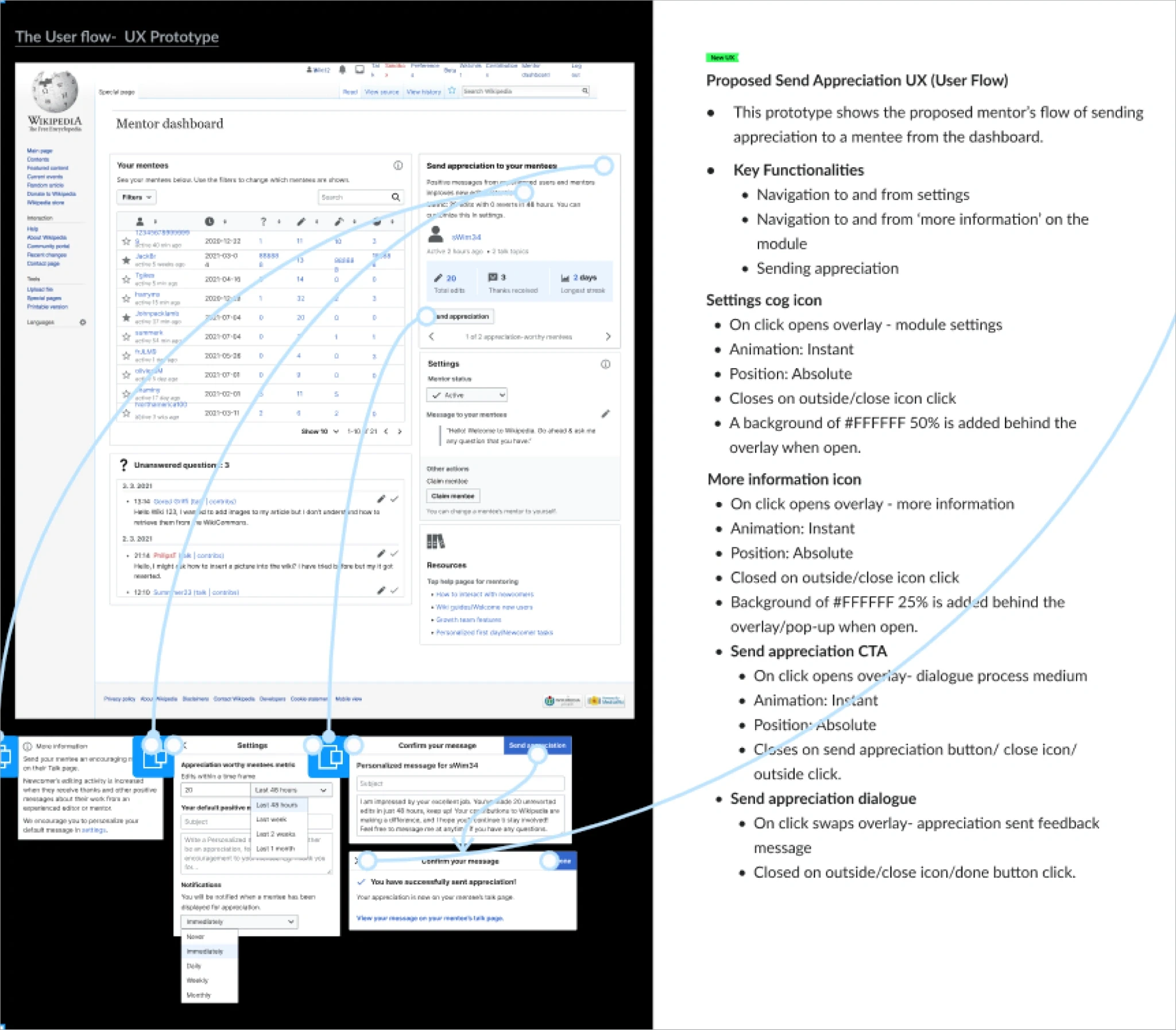
I designed a “Send Appreciation” module within the mentor dashboard to help experienced editors easily recognise and encourage newcomers.
Surfaces appreciation-worthy mentees based on customizable activity metrics
Provides clear contribution signals (edit count, streaks, thanks) to guide action
Enables quick, contextual feedback through a lightweight “send appreciation” flow
The system was designed to:
Make recognition intentional and data-informed
Fit naturally into mentors’ existing workflows
Encourage consistent, positive reinforcement at scale
KEY DESIGN DECISIONS
I focused on keeping the experience lightweight, actionable, and embedded into existing behavior:
Surface, don’t interrupt
Integrated the module into the mentor dashboard instead of creating a new flowUse signals, not assumptions
Relied on editable activity metrics so mentors define what “appreciation-worthy” meansReduce friction to act
Designed a quick “send appreciation” flow with minimal stepsSupport edge cases
Included a clear empty state when no mentees meet the criteria
Designed to make appreciation a consistent habit, not an afterthought, by embedding it directly into the mentor workflow.
IMPACT
The solution shifts appreciation from a manual, inconsistent action to a proactive and structured part of the mentor workflow.
Makes recognition timely and visible, increasing the likelihood of reinforcement
Reduces effort for mentors by surfacing high-potential mentees automatically
Encourages continued contribution through positive feedback loops